
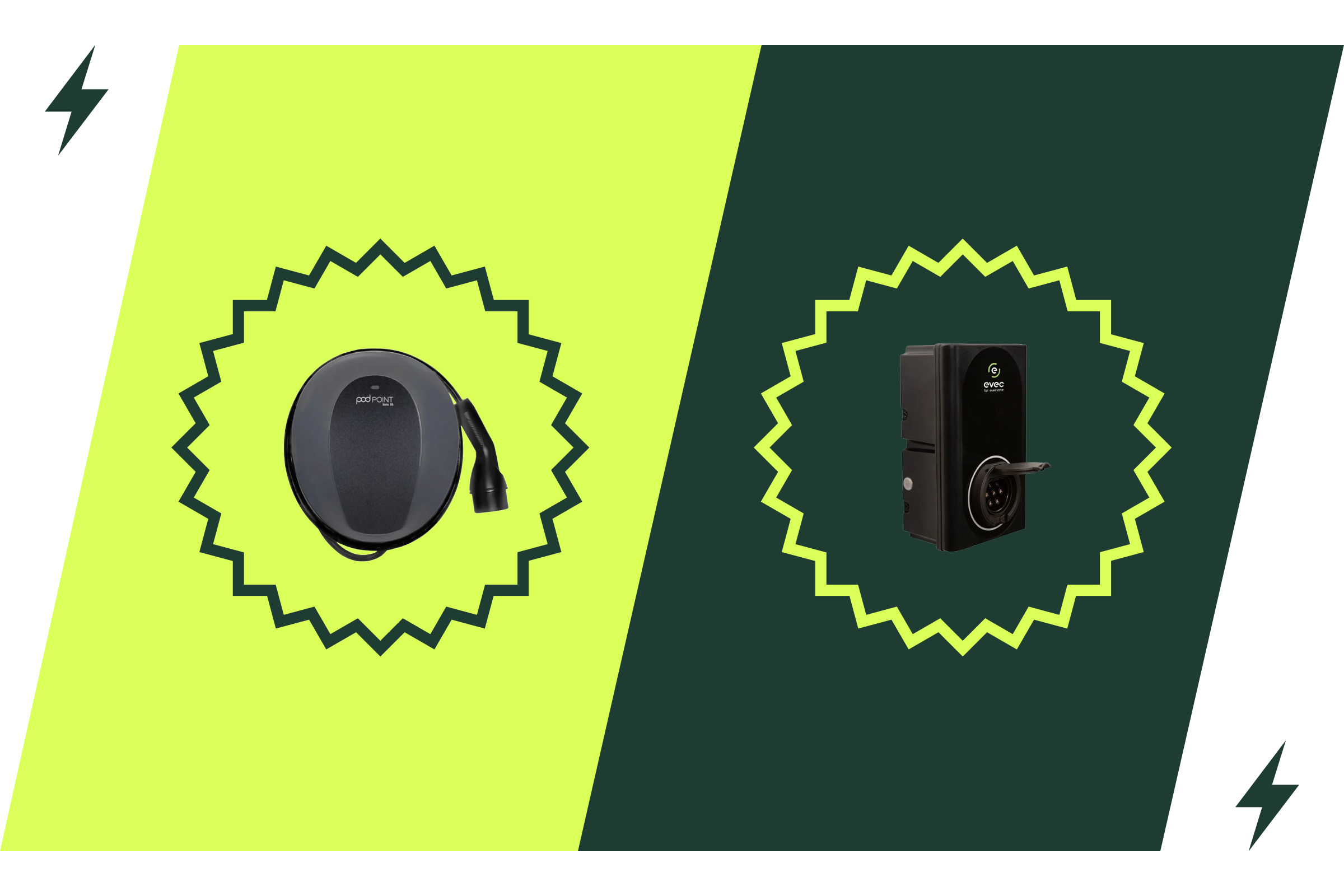
Choosing between a tethered or untethered EV charger is one of the first decisions you will make when buying a home or workplace charger. It is a simple choice, but it affects your day-to-day charging experience — so it is worth understanding the difference before you buy.
This guide explains what tethered and untethered mean, the pros and cons of each, which is better for different situations, and how much each type costs in the UK in 2026.
What is a tethered EV charger?
A tethered EV charger has a charging cable permanently attached to the unit. The cable is fixed at one end to the charger and has a Type 2 connector at the other end that plugs into your car. You cannot remove the cable — it is part of the charger.
To charge your car with a tethered charger, you simply grab the cable from its holster, walk over to your vehicle and plug it in. There is no second cable to fetch from the boot and no separate connection to make at the charger end. This makes the charging process as simple as plugging in a phone.
Most tethered chargers come with either a 5 metre or 6.5 metre cable as standard. Some brands offer longer cable options (up to 7.5m or 10m) at an additional cost. The cable length is worth considering — if your charger is mounted on the front of the house and your car's charge port is at the rear, you will need enough cable to reach comfortably.
What is an untethered EV charger?
An untethered EV charger (sometimes called a socketed charger) has a Type 2 socket on the front of the unit instead of a built-in cable. You supply your own separate charging cable — one end plugs into the charger's socket and the other plugs into your car.
The cable is not included with the charger. You will need to buy a Type 2 to Type 2 cable separately (typically £100–£200 depending on length and quality) or use the one that came with your electric vehicle. Most new EVs include a Type 2 cable in the boot as standard.
The main advantage of untethered chargers is flexibility. You can use different cables for different vehicles, choose a longer cable if you need more reach, and replace or upgrade the cable without replacing the charger. The charger itself also looks neater on the wall because there is no cable hanging from it when not in use.
Key differences at a glance
Here is a quick comparison of tethered vs untethered EV chargers covering the main factors that affect your decision.
| Tethered | Untethered | |
|---|---|---|
| Cable | Permanently attached (5m–6.5m typical) | Separate cable required (you supply) |
| Convenience | Grab and plug — one step | Two connections — charger end and car end |
| Flexibility | Fixed cable length and connector | Any Type 2 cable, any length |
| Multiple vehicles | Works with any Type 2 car | Works with any Type 2 car — different cables for different needs |
| Appearance | Cable visible when stored on holster | Cleaner look — no cable on wall |
| Charger cost | Slightly higher (cable included) | Slightly lower (cable not included) |
| Total cost | All-in price | Charger + cable (£100–£200 extra) |
| Charging speed | 7kW (home) or 22kW (commercial) | 7kW (home) or 22kW (commercial) — identical |
| Grant eligibility | OZEV and WCS eligible | OZEV and WCS eligible — identical |
| Best for | Single-car homes, convenience | Multi-car homes, shared chargers, commercial |
Which is better: tethered or untethered?
There is no universally better option — the right choice depends on your situation. Here is a simple decision guide.
Choose tethered if:
You have one electric car and charge in the same spot each time. Tethered chargers remove all friction from the charging process — you walk up, grab the cable, plug in and walk away. There is no cable to fetch from the boot, no fumbling with two connections, and no separate cable to store. For single-car households, tethered is the obvious choice and the one most people go with.
Choose untethered if:
You have two or more electric vehicles, you share a charger with neighbours or family members, or you want the option to upgrade your cable in the future. Untethered chargers also make sense if you care about the visual appearance of the charger on your wall — with no cable hanging from it, the charger looks cleaner when not in use. Some people also prefer untethered because they can take the cable with them and use it at public Type 2 charging points (such as destination chargers at hotels and supermarkets).
Does it affect charging speed?
No. Tethered and untethered chargers deliver exactly the same charging speed. A 7kW tethered charger charges at the same rate as a 7kW untethered charger. The cable arrangement does not affect power output, charging time or efficiency. Both types are also equally eligible for the OZEV grant (up to £350 off home installation) and the WCS grant for commercial installations.
Pros and cons
Tethered EV charger: pros and cons
| Pros | Cons |
|---|---|
| Maximum convenience — one plug, one step | Cable length is fixed at purchase |
| No separate cable to buy, carry or store | Cable visible on wall when not in use |
| Nothing to forget or leave behind | If the cable is damaged, the whole unit may need servicing |
| Most popular choice for home — widely available | Slightly more expensive than untethered equivalent |
Untethered EV charger: pros and cons
| Pros | Cons |
|---|---|
| Flexible — use any Type 2 cable, any length | Extra cost for a separate cable (£100–£200) |
| Cleaner look on the wall — no cable hanging | Less convenient — two connections each time |
| Cable can be replaced or upgraded easily | Cable needs to be stored somewhere when not in use |
| Take the cable with you for public Type 2 charging | Easy to forget the cable if you carry it in the boot |
| Better for multi-car households and shared chargers |
Best tethered EV chargers in the UK
Here are the most popular tethered EV chargers we stock, covering a range of budgets and features. All are 7kW smart chargers suitable for UK homes with a standard single-phase electricity supply.
| Charger | Cable | Price | Best for |
|---|---|---|---|
| Ohme Home Pro | 5m | From £531 | Smart tariff integration (Octopus, OVO) |
| MyEnergi Zappi 3 GLO | 6.5m | From £535 | Solar panel owners |
| Pod Point Solo 3S | 5m | From £530 | Simplicity and brand trust |
| VCHRGD Seven Pro | 7.5m | From £448 | Best value tethered option |
| EVEC VEC03 | 5m | From £369 | Budget-friendly tethered option |
| Andersen Quartz | 5m or 8.5m | From £730 | Premium design (100+ finishes) |
Browse the full range of 7kW tethered EV chargers or use our Find My Charger tool to filter by features, price and compatibility.
Best untethered EV chargers in the UK
Here are the most popular untethered EV chargers we stock. Remember that you will need a separate Type 2 to Type 2 cable (typically £100–£200) if your car did not come with one.
| Charger | Price | Best for |
|---|---|---|
| VCHRGD Seven Pro | From £390 | Best value smart charger |
| Indra Smart PRO | From £410 | V2G ready (future-proof) |
| Cord Zero | From £449 | Minimal design, easy setup |
| Pod Point Solo 3S | From £480 | Brand trust, clean design |
| Easee One | From £482 | Compact design, easy install |
| EVEC VEC01 | From £312 | Cheapest OZEV-approved smart charger |
| MyEnergi Zappi 2 | From £685 | Solar panel owners (untethered option) |
Browse the full range of 7kW untethered EV chargers. Not sure which charger suits you? Try our Find My Charger tool.
Tethered vs untethered for commercial and workplace chargers
For commercial and workplace EV chargers, the tethered vs untethered choice works slightly differently. Most commercial 22kW chargers are untethered — the charger has Type 2 sockets and each driver uses their own cable. This makes sense because a workplace or public charger will be used by many different vehicles, and the site operator does not want to manage or maintain cables that get heavy use from multiple drivers.
Some commercial chargers are available in tethered versions, which can be a good choice for fleet depots where the same vehicles use the same charge points every day. Tethered commercial chargers reduce the risk of cables going missing and speed up the charging process for fleet drivers.
Here are some popular commercial options in both configurations:
| Charger | Type | Power | Price |
|---|---|---|---|
| EVEC VECSPRINT EDW02 | Untethered (dual socket) | 22kW | From £1,320 |
| EVEC VEC04 | Tethered | 22kW | From £570 |
| Rolec EVO | Untethered | 22kW | From £469 |
| MyEnergi Zappi 2 | Both available | 7.4kW / 22kW | From £685 |
All commercial chargers are eligible for the WCS grant (up to £350 per socket). Browse our full range of 22kW commercial EV chargers.
Frequently asked questions
What does tethered mean on an EV charger?
Tethered means the charging cable is permanently attached to the charger unit. You cannot remove it. You simply grab the cable from the charger and plug the connector into your car. It is the same concept as a petrol pump — the hose is attached to the pump and you use it to fill up.
What does untethered mean on an EV charger?
Untethered means the charger has a socket (Type 2) and no built-in cable. You use a separate charging cable — one end plugs into the charger's socket, the other end plugs into your car. You supply your own cable, which gives you flexibility over cable length and lets you take the cable with you.
Can I use any cable with an untethered EV charger?
Yes — any Type 2 to Type 2 charging cable will work with an untethered charger. Cables come in different lengths (typically 5m, 7.5m or 10m) and different current ratings. For a 7kW home charger, you need a 32A-rated cable. Most new electric vehicles come with a Type 2 cable as standard, so check your boot before buying a separate one.
Is a tethered or untethered charger cheaper?
Untethered chargers are usually £50–£150 cheaper than the equivalent tethered version because the cable is not included. However, you will then need to buy a separate Type 2 cable (typically £100–£200), so the total cost often ends up similar. The cheapest untethered charger we stock is the EVEC VEC01 at £312. The cheapest tethered charger is the EVEC VEC03 at £369.
Do tethered and untethered chargers charge at the same speed?
Yes — both types charge at exactly the same speed. A 7kW tethered charger delivers the same 7kW as a 7kW untethered charger. The cable arrangement has no impact on charging speed, efficiency or performance. The charging speed is determined by the charger's power rating and your car's onboard AC charger, not by whether the cable is built-in or separate.
Can I change a tethered charger to untethered (or vice versa)?
No — you cannot convert between tethered and untethered after installation. The cable arrangement is built into the charger at the factory. If you currently have a tethered charger and want to switch to untethered (or the other way around), you would need to replace the charger unit. This is worth keeping in mind if you plan to change vehicles in the future — an untethered charger gives you more long-term flexibility.
Which type is better if I have solar panels?
Both tethered and untethered chargers work equally well with solar panels — the solar integration depends on the charger's software, not the cable type. The MyEnergi Zappi is the UK's most popular solar-compatible charger and is available in both tethered and untethered versions. The Zappi 3 GLO is tethered only (£535), while the Zappi 2 comes in both options (untethered from £685).
Should I choose tethered or untethered for a workplace charger?
For most workplace and commercial installations, untethered is the standard choice. Different employees will use the charger with different vehicles, and each driver can bring their own cable. Untethered also reduces the risk of cable damage from heavy shared use. For fleet depots where the same vehicles always use the same charge points, tethered can be more practical. See our full range of commercial EV chargers or read our EV charger installation guide.