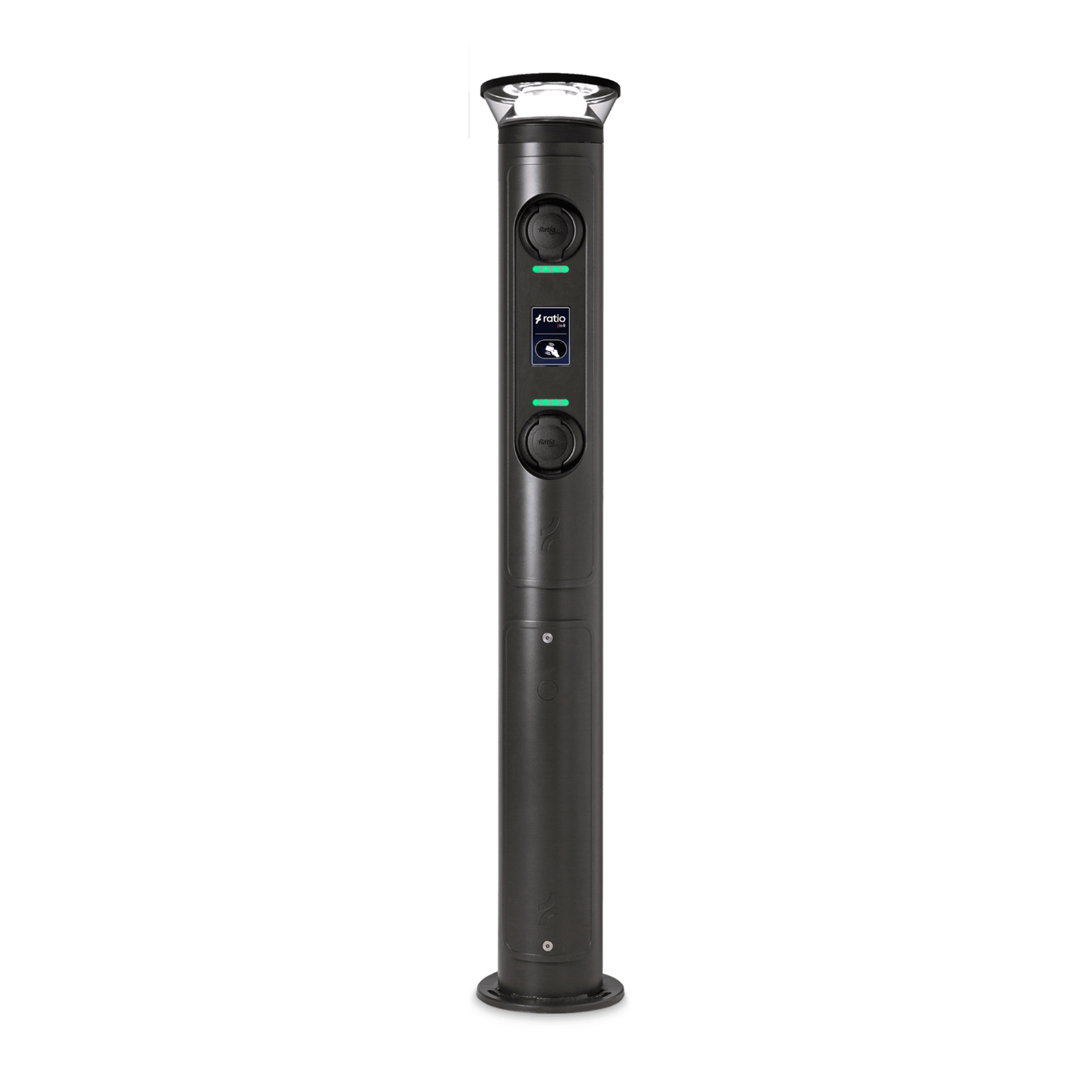
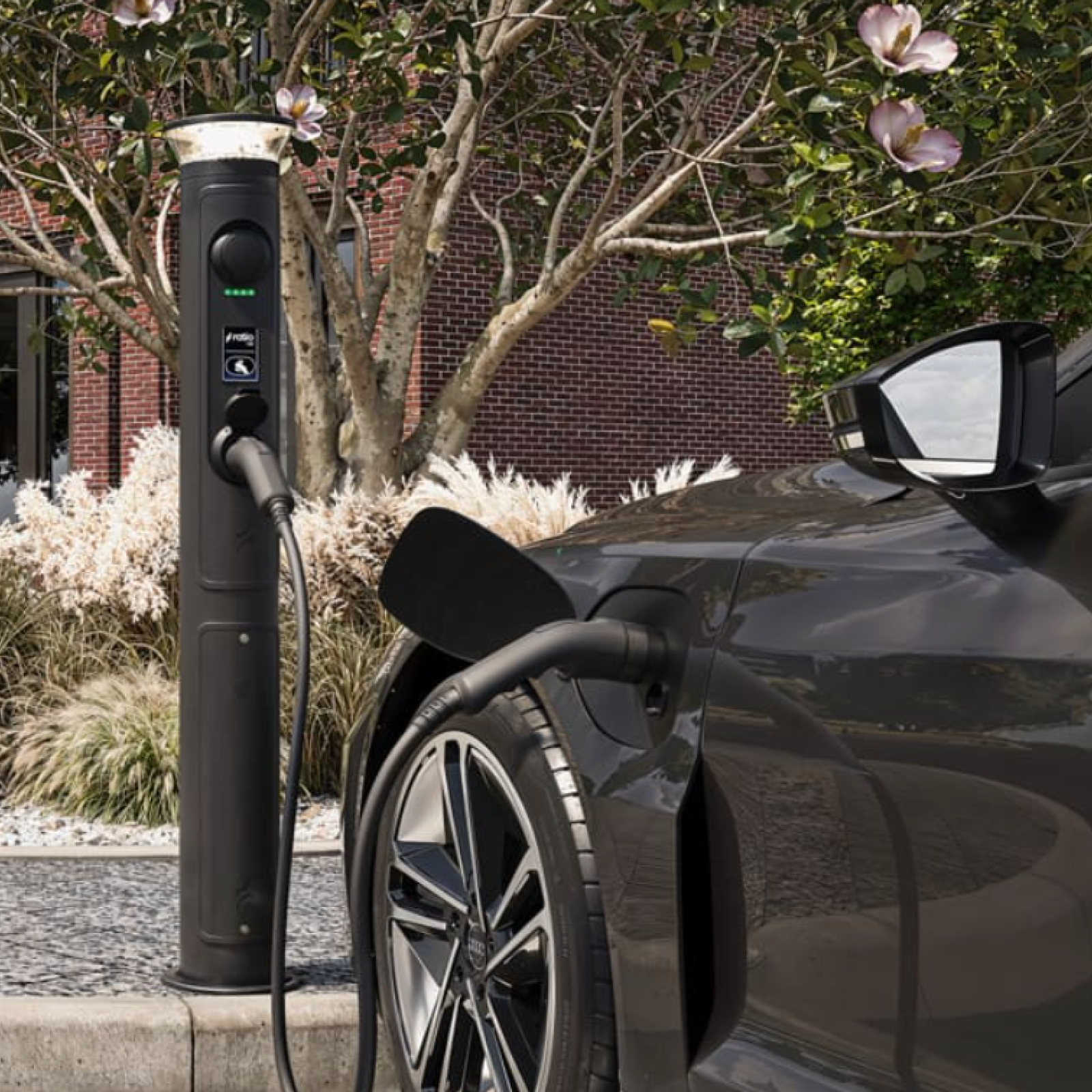
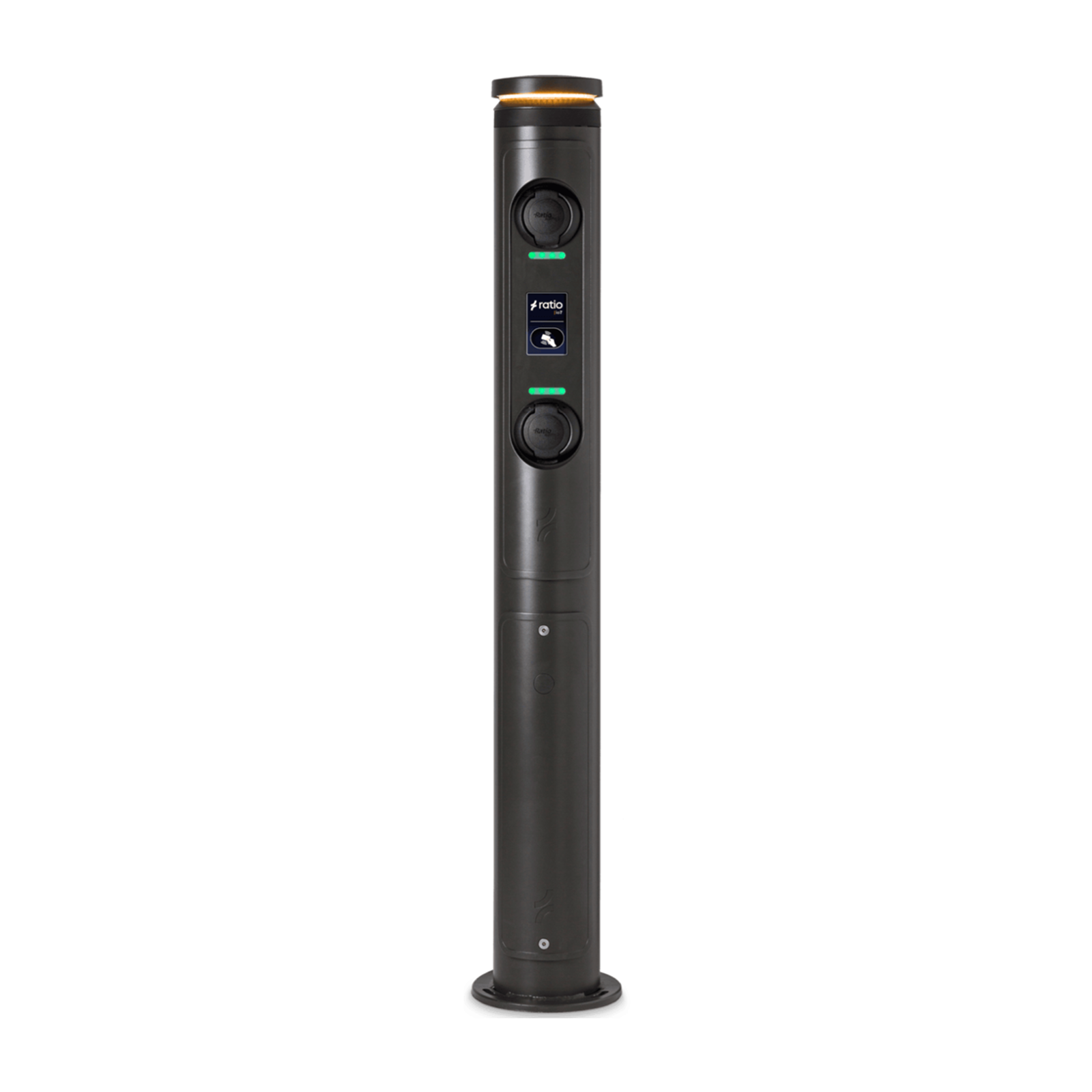
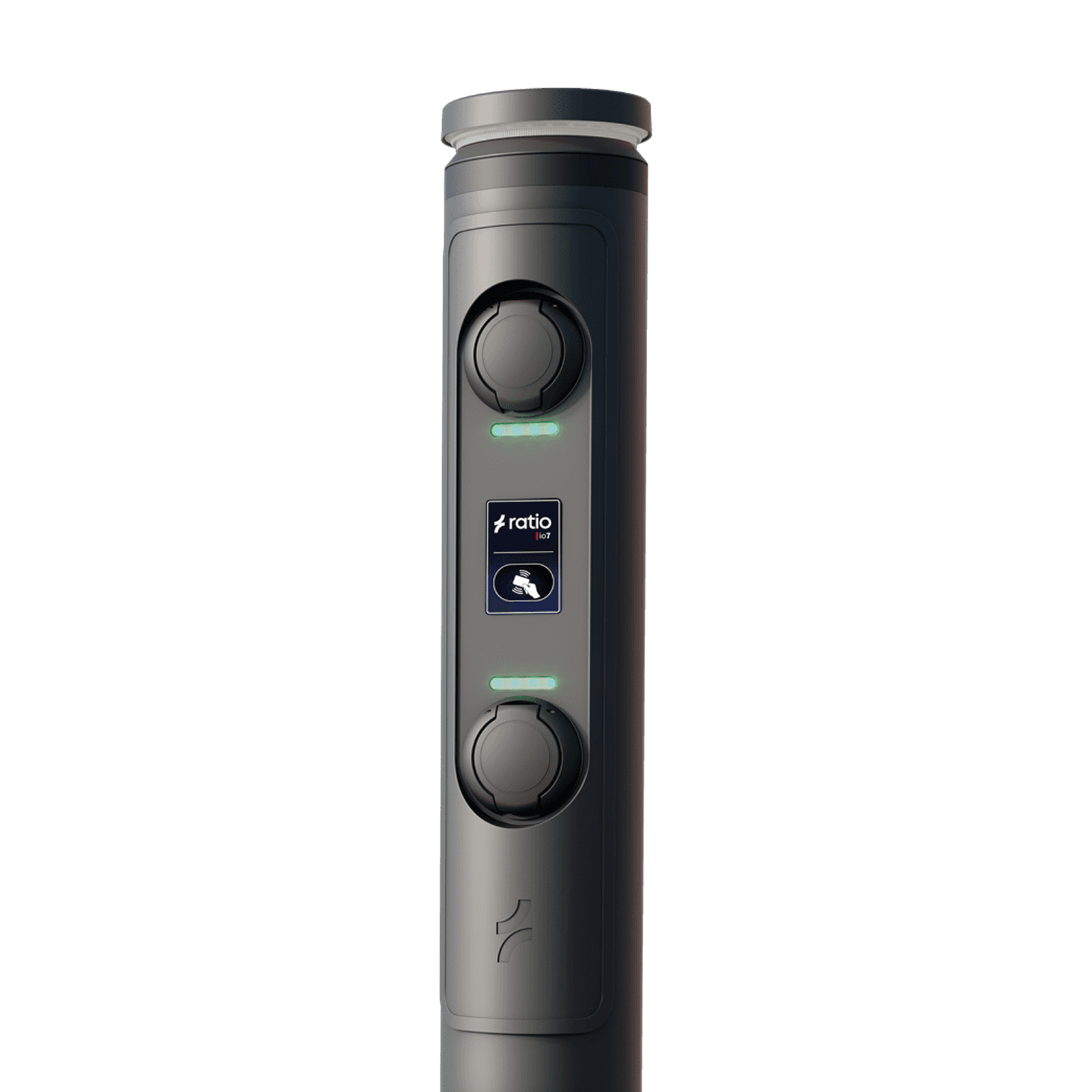
Ratio EV chargers are commercial-grade dual socket units for workplaces, car parks, shared residential developments and fleet sites — every model charges two vehicles at once. We stock 8 Ratio products across the io7 and io8 ranges, in 7.4kW single-phase and 22kW three-phase, each with a choice of CT or MID metering. Prices run from £2,300 to £2,970 with free UK delivery. All include CT load balancing, integrated LED lighting, RFID access, OCPP 1.6 and OZEV grant approval.
Ratio makes two dual socket ranges, the io7 and the io8, and we stock both in every configuration. Each is available in 7.4kW single-phase (from £2,300) and 22kW three-phase (from £2,650), with a choice of CT metering or MID-certified metering. That gives eight combinations in total. The practical difference between io7 and io8 is form factor and lighting treatment rather than charging capability — both deliver full power to each socket, carry the same OCPP 1.6 support and RFID access, and qualify for the same grants. Choose on how the unit needs to look and sit on site.
How much do Ratio EV chargers cost?
Ratio prices start at £2,300 for the io7 or io8 7.4kW dual socket with CT metering, rising to £2,600 for the MID-metered 7.4kW versions, £2,650 to £2,660 for 22kW with CT metering and £2,950 to £2,970 for 22kW with MID metering. All include free UK delivery. These are two charging points per unit, so on a per-socket basis they compare directly against two single socket chargers plus the second set of groundworks, cabling and connection — which is usually where the dual unit wins on a multi-bay site.
What is the difference between CT and MID metering?
CT metering uses a current transformer to measure how much power the charger is drawing. It is accurate enough for load balancing, energy reporting and internal cost allocation, and it is the cheaper option — £300 less per unit across the Ratio range. MID metering is certified to the Measuring Instruments Directive, which means the readings are legally accepted for billing. If you intend to charge drivers per kWh — tenants, the public, or anyone paying for the electricity they use — you need MID. If charging is free at the point of use and you only need to know the numbers internally, CT is sufficient.
Are Ratio chargers suitable for pay-per-use charging?
Yes, with the MID-metered versions. MID certification is what makes billing by the kWh legally compliant in the UK, so the io7 and io8 MID models are the ones to specify for public or tenant-facing charging. Pair them with a payment terminal from our commercial payment systems range, or manage sessions and billing through the Ratio app or any OCPP 1.6 back office. For sites that want payment built into the charger itself rather than added alongside it, the Nayax EV Meter Pay range is the more direct route.
What is CT load balancing and why does it matter?
CT load balancing monitors the total power a site is drawing and automatically reduces the charger's output when demand rises elsewhere, so the incoming supply is never overloaded. On a commercial site this is often the difference between a charging installation that goes ahead and one that needs an expensive supply upgrade from the DNO first — load balancing lets you install more charging capacity than the raw headroom would otherwise allow, because the chargers give way to the rest of the building. Every Ratio unit includes it as standard. See our load management range for standalone devices.
Are Ratio chargers eligible for the Workplace Charging Scheme?
Ratio chargers carry OZEV grant approval, and because every unit is dual socket it counts as two sockets under the Workplace Charging Scheme — up to £350 each, so up to £700 per charger, within the 40-socket cap. That materially changes the maths on a multi-unit installation. The scheme is open to businesses, charities and public sector organisations with off-street parking for staff or fleet, and the charger must be fitted by an OZEV-authorised installer. Read our guide to EV charger grants available in 2026.