FuseBox
1 product
Showing 1 - 1 of 1 product
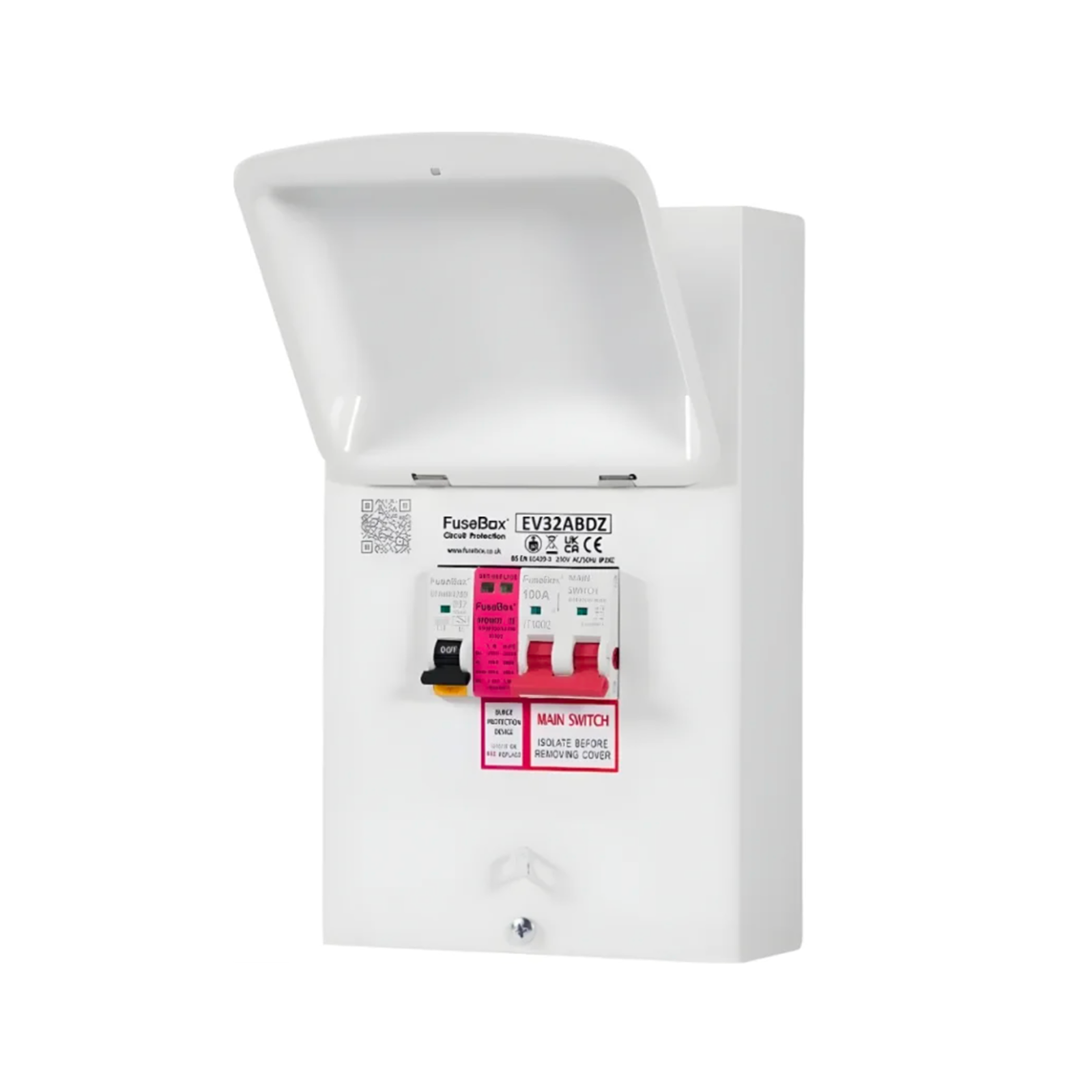
FuseBox consumer units and protective devices are the electrical side of an EV charger installation — the dedicated supply, protection and surge suppression that sits between the incoming supply and the charge point. We stock the FuseBox EV32ABDZ consumer unit at £72: a 32A Type A bi-directional RCBO with a 100A main switch and integrated Type 2 SPD in a steel enclosure, purpose-built for compliant EV charging circuits and manufactured to BS EN 61439-3. Free UK delivery.
FuseBox Consumer Units / All Consumer Units / Installer Equipment / EV Installation Kits
What FuseBox products are available?
We stock the FuseBox EV32ABDZ, a dedicated EV charger supply unit priced at £72. It combines a 100A main switch incomer, a 32A Type A bi-directional RCBO and an integrated Type 2 surge protection device in a robust steel enclosure with a white RAL 9001 finish. At 261 x 152 x 93mm it is a compact wall-mounted unit designed to sit alongside an existing consumer unit rather than replace it, giving the charge point its own protected supply. It is built to BS EN 61439-3 and includes installer-friendly touches such as a removable DIN rail, captive screws and multiple cable entry knockouts.
Why does an EV charger need its own consumer unit?
An EV charger draws close to its rated current continuously for hours at a time, which is a very different load profile from sockets and lighting. Giving it a dedicated supply unit means the charging circuit has its own correctly rated protection, keeps the charger off shared RCDs where a fault elsewhere in the house would cut charging, and avoids the cost and disruption of upgrading a whole consumer unit that is otherwise fine. It also makes the installation easier to inspect and certify. See our full consumer units range and EV installation kits.
What is a bi-directional RCBO and why does it matter?
A bi-directional RCBO is designed to work correctly when current can flow in either direction through it — which is exactly what happens on a property with solar PV, battery storage or vehicle-to-home charging, where power may be exported as well as imported. A conventional single-direction device is not specified for that. Fitting the bi-directional version now means the same board still works if solar panels or a battery are added later, which is increasingly likely on any property having an EV charger installed today.
What does the integrated SPD do?
The Type 2 surge protection device protects the charger and anything connected to it from transient overvoltages — the short, high-voltage spikes caused by nearby lightning strikes or switching events on the network. EV chargers contain sensitive electronics and sit on an outside wall at the end of a long cable run, which makes them more exposed than most household equipment. Having the SPD built into the same enclosure saves a separate device and the extra way it would occupy, and keeps the installation compliant with current wiring regulations for surge protection.
Where does the FuseBox EV32ABDZ fit in an installation?
It mounts on the wall near the existing consumer unit, is fed from the main supply and feeds out to the charge point on a dedicated circuit. The 100A main switch allows the charging circuit to be isolated independently of the rest of the property, which is useful for maintenance and for fault-finding on the charger itself. Note that many modern chargers already include PEN fault detection and 6mA DC protection internally — check the charger specification, as this affects what external protective devices are required. See our EV charger installation guide for a walkthrough of a typical install.